

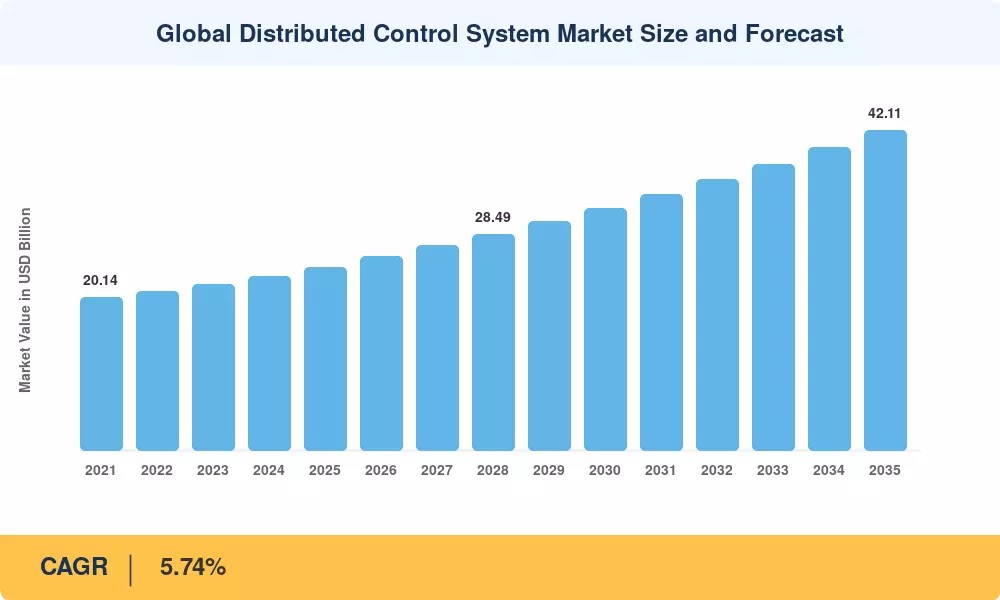
Distributed Control System Market to Reach USD 42.11 Billion by 2035 at 5.74% CAGR.
Distributed Control System Industry
Hardware accounted for 52.2% of the Distributed Control System Market in 2025, reflecting the capital-intensive nature of controller and I/O replacements.
Software revenue is set to register a 6.38% CAGR through 2035 as containerized analytics and digital-twin subscriptions gain traction.”
NEW YORK, NY, UNITED STATES, July 24, 2026 /EINPresswire.com/ -- The Distributed Control System Market was valued at USD 24.10 billion in 2025 and is projected to grow from USD 25.48 billion in 2026 to USD 42.11 billion by 2035, expanding at a 5.74% CAGR during the forecast period.— Prashant Hake
Market Overview
Distributed Control Systems Industry are industrial automation platforms that provide centralized monitoring and distributed control over large-scale, complex manufacturing and process operations. Unlike programmable logic controllers (PLCs) designed for discrete control, DCS architectures utilize a network of controllers distributed throughout a facility, communicating via high-speed digital networks to coordinate production processes across entire plants. These systems integrate HMIs, application software, and communication networks to enable precise, real-time control of process variables including temperature, pressure, flow, and level. DCS solutions are widely deployed in continuous production industries such as oil and gas, power generation, chemical processing, pharmaceutical manufacturing, and water and wastewater treatment.
Growth Drivers
The market's steady expansion is anchored in several converging forces. The accelerating pace of industrial automation, driven by the fourth industrial revolution, is compelling process industries to modernize legacy control systems with advanced DCS solutions capable of supporting predictive maintenance, real-time monitoring, and production optimization. The growing adoption of Internet of Things (IoT) technologies is another pivotal driver, enabling DCS platforms to collect and analyze data from thousands of sensors and equipment across plants, improving operational efficiency and enabling remote monitoring and maintenance. The integration of artificial intelligence (AI) and machine learning (ML) capabilities into DCS platforms is enhancing predictive analytics and improving decision-making capabilities in process industries.
The proliferation of edge computing is enabling faster, on-site data processing, facilitating real-time actionable insights and improving network reliability. Additionally, process industries such as oil and gas, power generation, pharmaceuticals, and food and beverage require precise control over production processes to maintain product quality and safety. The need for comprehensive cyber-security solutions to protect critical infrastructure is also driving demand for modern DCS solutions. Governments worldwide are implementing stringent safety and emission regulations, accelerating the modernization of legacy control systems.
Industry Trends & Technological Developments
The DCS market is witnessing a paradigm shift toward cloud-based and subscription-based DCS solutions, enabling remote monitoring and control capabilities. Integration of advanced technologies such as AI, ML, and industrial IoT is transforming traditional DCS platforms from centralized monitoring systems into intelligent autonomous assets. Artificial intelligence is being increasingly integrated into DCS, enabling predictive maintenance, anomaly detection, and autonomous control capabilities. In November 2024, ABB launched a brand-new distributed control system with artificial intelligence capabilities to support autonomous operations and optimize production.
The development of wireless communication technologies is facilitating data transmission, enabling remote monitoring and control. Advancements in microprocessors and software have led to the development of more sophisticated and reliable DCS that can handle complex processes with high efficiency. The shift towards digital twin technology is gaining momentum, allowing manufacturers to simulate production processes and identify optimization opportunities. The integration of cyber-security features directly into DCS architectures is becoming standard practice, addressing growing concerns about protecting critical infrastructure.
Policy & Regulatory Influence
Regulatory frameworks play a pivotal role in shaping the market. Governments worldwide are implementing stringent safety and environmental regulations that mandate precise monitoring and control over industrial processes, creating sustained demand for reliable and advanced DCS solutions. The U.S. Environmental Protection Agency (EPA) and the European Union's Industrial Emissions Directive continue to tighten emission standards, driving modernization of aging control systems. In the power generation sector, grid reliability standards are compelling utilities to upgrade DCS capabilities. The adoption of Industry 4.0 and smart manufacturing initiatives in countries like China (Made in China 2025), Germany (Industry 4.0), and the U.S. (Smart Manufacturing Leadership Coalition) is promoting the integration of advanced DCS solutions.
Demand Outlook
The demand outlook remains positive, driven by rapid industrialization in developing economies, modernization of aging industrial plants, and the global push for sustainable and efficient industrial operations. Asia-Pacific is expected to witness the highest growth rate, fueled by industrial growth in China, India, and Southeast Asian countries, along with government initiatives promoting digitalization and automation. The oil and gas sector remains the largest end-user of DCS, while the pharmaceutical and chemical sectors are seeing accelerated adoption due to stringent quality requirements. The increasing number of process industry facilities worldwide requiring centralized control for complex automation tasks is driving consistent demand.
Get Free Sample Report for Detailed Market Insights:
https://www.marketresearchfuture.com/sample_request/1698
Market Segmentation
The Distributed Control System Market is comprehensively segmented to capture diverse industry dynamics and application requirements.
By Component
Hardware: The largest segment, encompassing controllers, servers, workstations, I/O modules, and communication networks. Software: Fastest-growing segment, including HMI software, process control software, AI/ML analytics, and remote monitoring platforms. Services: Includes consulting, system integration, maintenance, and support services essential for successful DCS deployment and optimization.
By Application
Continuous Process: Dominant application segment for industries such as oil and gas, power generation, and chemicals requiring uninterrupted process control. Batch Process: Significant segment for pharmaceutical, food and beverage, and specialty chemical manufacturing requiring recipe-based production control.
By End-User Industry
Oil & Gas: The largest end-user segment, driven by the need for precise control over exploration, production, refining, and pipeline operations. Power Generation: High-growth segment driven by grid modernization and integration of renewable energy sources. Chemical & Petrochemical: Significant demand for precise control over complex chemical reactions and processes. Pharmaceutical: Fast-growing segment due to stringent FDA and GMP requirements for process validation and traceability. Others: Including food and beverage, water and wastewater, pulp and paper, and metals and mining.
You can buy this market report at:
https://www.marketresearchfuture.com/checkout?currency=one_user-USD&report_id=1698
Regional Analysis
North America
North America is a mature market characterized by the presence of established automation infrastructure and leading DCS vendors such as Emerson, Honeywell, ABB, and Rockwell Automation. The U.S. dominates the regional market due to its robust oil and gas, power generation, and chemical industries. The region's well-established process industries and early adoption of industrial automation technologies contribute to its significant market share. Increasing investment in digitalization projects and modernization of aging infrastructure, driven by regulatory requirements and operational efficiency goals, is sustaining demand. The replacement and upgrade of legacy DCS systems represent a significant growth opportunity in the U.S. market.
Europe
Europe represents another mature market with a strong emphasis on environmental compliance and energy efficiency. The region is known for its early adoption of Industry 4.0 technologies, with leading DCS manufacturers such as Siemens, ABB, and Schneider Electric driving innovation. Stringent environmental regulations and the increasing adoption of automation in pharmaceutical and food and beverage industries are major market drivers. The growth of renewable energy projects and the expansion of grid infrastructure are also contributing to demand for advanced DCS solutions.
Asia-Pacific
Asia-Pacific is the largest and fastest-growing regional market, driven by rapid industrialization and urbanization in countries such as China, India, Japan, and South Korea. China leads the region with its massive manufacturing base and aggressive implementation of smart factory initiatives under its Made in China 2025 policy. India's growing infrastructure and manufacturing sectors, supported by government initiatives like Make in India, are creating substantial demand. The region's expanding oil and gas and chemical industries, coupled with rising investments in automation and digitalization, are major growth drivers. The increasing demand for energy, combined with the expansion of power generation capacity, is further boosting market growth.
Rest of the World
Latin America and the Middle East & Africa represent emerging markets with expanding industrial bases and growing automation demand. Brazil and Mexico lead Latin American adoption, driven by increasing industrial investments in oil and gas, chemical, and food processing sectors. The Middle East, particularly Saudi Arabia and the UAE, is witnessing substantial investments in hydrocarbon infrastructure and diversification into manufacturing, creating opportunities for DCS deployment. Africa's mining and power generation sectors are gradually adopting advanced automation technologies.
Competitive Landscape / Key Players
The Distributed Control System Market is dominated by a few global players with diverse product portfolios and significant R&D investments. The market is characterized by strategic partnerships, acquisitions, and continuous innovation.
Key Companies
ABB Ltd.: A global leader with comprehensive DCS solutions, recently launching AI-capable systems for autonomous operations.
Emerson Electric Co.: Offers the DeltaV™ platform with advanced automation capabilities for process industries.
Honeywell International, Inc.: A key player with advanced DCS solutions for oil and gas, chemicals, and power generation.
Siemens AG: Provides comprehensive industrial automation solutions, with strong expertise in European markets.
Rockwell Automation: A major player focusing on process and hybrid industries, leveraging IoT and analytics integration.
Schneider Electric SE: Offers EcoStruxure architecture for integrated process control and energy management.
Yokogawa Electric Corporation: Strong presence in Asia-Pacific and expanding global footprint through acquisitions.
Mitsubishi Heavy Industries and Hitachi Ltd.: Additional significant contributors to the market.
Strategic Developments
Key players are employing several strategic initiatives to strengthen market presence. Companies are investing heavily in AI, machine learning, and cloud integration for next-generation DCS platforms. Strategic acquisitions and partnerships are enabling expansion of product portfolios and market reach. In November 2024, ABB launched a brand-new distributed control system with artificial intelligence capabilities. Siemens has reached agreements to acquire industrial technology businesses to reinforce its digital factory automation capabilities. Yokogawa's acquisition of Adept Fluidyne Pvt. Ltd. in India, announced in March 2024, demonstrates strategy to establish local manufacturing bases and expand product portfolios in high-growth markets.
Latest Industry News & Developments
ABB Launches AI-Powered Distributed Control System: In November 2024, ABB launched a brand-new distributed control system with artificial intelligence capabilities to support autonomous operations and optimize production.
Siemens Expands Industrial Automation Portfolio: Siemens has reached agreements to acquire industrial technology businesses, reinforcing its digital factory automation capabilities and expanding its DCS portfolio.
Yokogawa Acquires Adept Fluidyne in India: In March 2024, Yokogawa Electric Corporation announced the acquisition of Adept Fluidyne Pvt. Ltd., a provider of control valves and automation solutions, to expand its manufacturing footprint and customer base in the Indian market.
Market Challenges & Opportunities
Key Restraints
High Cost of Implementation: The significant investment required for DCS hardware, software, and installation can be prohibitive for smaller enterprises, particularly in emerging markets. Security and Integration Complexity: Integrating modern DCS with legacy systems presents technical challenges, while cybersecurity threats to critical infrastructure require continuous vigilance and investment. Need for Skilled Professionals: The requirement for specialized skills to design, implement, and maintain DCS creates a shortage of qualified personnel, limiting adoption in some regions. Long Return on Investment Period: The payback period for DCS investments can be extended, potentially discouraging capital-intensive upgrades in price-sensitive markets.
Emerging Opportunities
Digital Transformation and Smart Manufacturing: The global push toward Industry 4.0 and smart manufacturing creates substantial opportunities for DCS modernization and expansion, particularly in developing economies where industrial automation is still in early stages. Integration with IIoT and AI: The integration of DCS with Industrial Internet of Things and artificial intelligence enables real-time monitoring, predictive maintenance, and autonomous operations, unlocking new value for process industries. Pharmaceutical and Food & Beverage Industries: Stringent regulatory requirements and the need for precise process control are driving adoption in these high-growth sectors. Renewable Energy and Power Generation: The expansion of grid infrastructure and renewable energy sources creates demand for advanced control systems to manage complex, distributed power generation networks. Cloud-Based and Subscription Models: The shift toward cloud-based DCS solutions with lower upfront investment and scalable capabilities is opening new opportunities for smaller enterprises.
To explore more market insights, visit us at:
https://www.marketresearchfuture.com/reports/global-distributed-control-system-market-1698
Final Market Summary
The Distributed Control System Market is positioned for steady and sustained growth, with projections indicating expansion from USD 24.10 billion in 2025 to USD 42.11 billion by 2035, at a CAGR of 5.74%. This growth is underpinned by accelerating industrial automation, the digital transformation of process industries, stringent regulatory requirements for emissions and safety compliance, and the integration of AI, IoT, and cloud technologies into control system architectures. While challenges such as high implementation costs, integration complexity, and skill shortages persist, emerging opportunities in smart manufacturing, renewable energy integration, and cloud-based DCS solutions offer substantial potential for industry participants. The future market landscape will be defined by companies that successfully innovate in AI and IoT integration, navigate evolving regulatory requirements, and deliver scalable, secure solutions across diverse process industries.
More Related Reports from MRFR Library:
Power Quality Equipment Market: https://www.marketresearchfuture.com/reports/power-quality-equipment-market-3088
Subsea Manifolds Market: https://www.marketresearchfuture.com/reports/subsea-manifolds-market-3138
Busbar Trunking System Market: https://www.marketresearchfuture.com/reports/busbar-trunking-system-market-3147
Drill Pipe Market: https://www.marketresearchfuture.com/reports/drill-pipe-market-3154
Synchronous Condenser Market: https://www.marketresearchfuture.com/reports/synchronous-condenser-market-3169
Distribution Boards Market: https://www.marketresearchfuture.com/reports/distribution-boards-market-3197
Frequency Converter Market: https://www.marketresearchfuture.com/reports/frequency-converter-market-3218
Solar Panels Market: https://www.marketresearchfuture.com/reports/solar-panels-market-3237
Pressure Vessel Market: https://www.marketresearchfuture.com/reports/pressure-vessel-market-3243
Power Transformer Market: https://www.marketresearchfuture.com/reports/power-transformer-market-3251
Larry Wilson
WantStats Research And Media Pvt. Ltd.
+ +1 855-661-4441
email us here
Visit us on social media:
LinkedIn
Facebook
YouTube
X
Legal Disclaimer:
EIN Presswire provides this news content "as is" without warranty of any kind. We do not accept any responsibility or liability for the accuracy, content, images, videos, licenses, completeness, legality, or reliability of the information contained in this article. If you have any complaints or copyright issues related to this article, kindly contact the author above.
