

Electric Vehicle Motor Controller Market Share to Hit USD 4,240 Million, at 28.0% CAGR During the Forecast 2026 to 2035
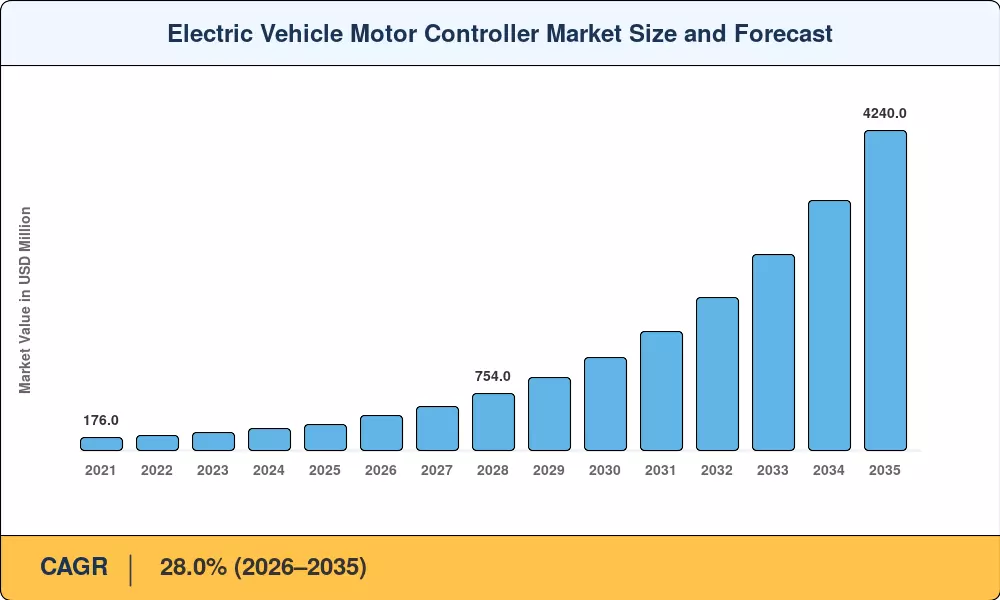
Electric Vehicle Motor Controller Market Summary
Asia-Pacific captured approximately 45% share of the electric vehicle motor controller market in 2025 and remains fastest-growing region at around 31.2% CAGR.
AC Induction motors represented the largest segment of the electric vehicle motor controller market in 2025, with 65% share, favored for cost-effective designs in high-volume passenger platforms.”
NY, CA, UNITED STATES, July 3, 2026 /EINPresswire.com/ -- The electric vehicle motor controller market reached an estimated USD 350 Million in 2025 and is projected to grow from USD 460 Million in 2026 to USD 4,240 Million by 2035, registering a compound annual growth rate of 28.0% during the forecast period.— Arti Dhapte
Electric Vehicle Motor Controller Market Overview
The electric vehicle motor controller market trends serves as the critical intelligence hub of an electric powertrain, functioning as the intermediary between the battery pack and the electric motor. This sophisticated electronic device regulates the flow of electrical energy from the battery to the motor, controlling essential parameters including torque delivery, speed regulation, acceleration response, and regenerative braking. Beyond basic power management, modern motor controllers integrate advanced functionalities such as thermal management, battery health monitoring, and powertrain safety protocols across both battery electric vehicle (BEV) and plug-in hybrid electric vehicle (PHEV) platforms . The controller translates driver inputs—accelerator pedal position, brake application, and steering angle—into precise electrical signals that determine motor output, making it indispensable for vehicle performance and efficiency.
The market for electric vehicle motor controllers is experiencing explosive growth driven by the accelerating global transition toward electric mobility. Global EV registrations surpassed 14 million units in 2023, representing a 40% year-on-year increase, with electric vehicles accounting for 18% of total vehicle sales worldwide . Stringent greenhouse gas emission regulations are compelling automotive OEMs to accelerate EV development and production timelines, directly increasing demand for advanced motor control systems. The rapid adoption of wide-bandgap silicon-carbide (SiC) semiconductors enabling 800-volt architectures—which significantly cut charging time and improve overall powertrain efficiency—is further propelling market expansion . The production of electric car motor controllers reached approximately 18.52 million units globally in 2024, with an average global market price of around USD 361 per unit .
Industry trends indicate a decisive shift toward higher-voltage architectures and more sophisticated control algorithms. Field-Oriented Control technology currently dominates the market, providing precise torque and speed control across various operating conditions. Direct Torque Control is gaining traction as the fastest-growing technology segment, offering rapid torque response without requiring complex position sensors . The industry is also witnessing integration of artificial intelligence and machine learning into motor controllers, enabling predictive maintenance, adaptive performance optimization, and enhanced vehicle control . The evolution from traditional 8-bit and 16-bit microcontrollers toward 32-bit and multi-core processor architectures allows for more complex control algorithms and real-time data processing capabilities .
Technological developments are reshaping the EV motor controller landscape at an unprecedented pace. The transition from traditional silicon-based power electronics to wide-bandgap semiconductors—particularly silicon carbide and gallium nitride—is enabling higher switching frequencies, reduced power losses, and smaller form factors. The shift toward 800-volt electrical architectures across premium and increasingly mainstream passenger cars requires motor controllers capable of handling higher voltages while maintaining efficiency and reliability . Advanced thermal management solutions, including liquid cooling and advanced heat sink designs, are being integrated to manage the heat generated by high-power controllers. The emergence of integrated, all-in-one powertrain modules combining the motor, inverter, and reducer into a single compact unit is a significant development, reducing weight, cost, and packaging space for OEMs.
📍 Get Free Sample Report for Detailed Market Insights:
https://www.marketresearchfuture.com/sample_request/35899
Market Segmentation
By Motor Type
The electric vehicle motor controller market is segmented by motor type into AC Induction Motors, Permanent-Magnet Synchronous Motors (PMSM), Brushless DC Motors, and Others. Permanent Magnet Synchronous Motors represent a dominant segment due to their high efficiency, superior power density, and excellent torque characteristics across a wide speed range. PMSM controllers require sophisticated algorithms to manage the complex relationship between rotor position and stator current, driving demand for advanced control electronics. AC Induction Motor controllers, while slightly less efficient than PMSM, offer advantages in cost and robustness, particularly for applications where rare-earth magnet supply is a concern. Brushless DC Motors are gaining traction in two-wheeler and light EV applications due to their simplicity, reliability, and cost-effectiveness.
By Communication Protocol
Communication protocol segmentation includes CAN 2.0, CAN-FD, Automotive Ethernet, and Others. CAN 2.0 remains widely adopted as the industry-standard communication protocol for in-vehicle networks, providing reliable, deterministic communication between the motor controller and other vehicle systems. CAN-FD (Flexible Data-rate) is gaining adoption as data requirements increase, offering higher bandwidth and larger data payloads. Automotive Ethernet represents the most advanced protocol, supporting the high-speed data transmission required for sophisticated autonomous driving and connected vehicle features. The integration of advanced communication protocols is becoming a pivotal trend in the market, with Ethernet adoption accelerating as software-defined vehicle architectures become mainstream .
By Vehicle Type
Vehicle type segmentation covers Passenger Cars, Light Commercial Vehicles, and Medium & Heavy Commercial Vehicles. Passenger cars represent the largest segment, driven by global EV production volumes and the increasing value of motor controller content per vehicle. Light commercial vehicles, including delivery vans and small trucks, are experiencing growing demand as e-commerce expansion drives fleet electrification. Medium and heavy commercial vehicles, including electric buses and long-haul trucks, represent a high-growth segment requiring controllers capable of handling substantial power outputs and providing robust performance under demanding operating conditions.
By Propulsion Type
Propulsion type segmentation includes Battery Electric Vehicles (BEV), Plug-in Hybrid Electric Vehicles (PHEV), and Fuel-Cell Electric Vehicles (FCEV). BEVs dominate the market, accounting for the substantial majority of motor controller demand due to their reliance on electric drivetrains for all propulsion requirements . PHEVs represent a growing segment, requiring controllers capable of managing the interaction between electric and internal combustion powertrains. FCEVs remain a nascent but emerging market, with hydrogen fuel cell vehicles requiring specialized motor controllers that manage power from both the fuel cell and the buffer battery. The rising sales of battery electric vehicles across the world drive the growth of motor controllers, as factors such as growing demand for improving the efficiency of electric motors and increasing motor torque and speed control provide impetus to market expansion .
🛒 You can buy this market report at:
https://www.marketresearchfuture.com/checkout?currency=one_user-USD&report_id=35899
Regional Analysis
North America
North America remains the largest market for electric vehicle motor controllers in terms of revenue, reflecting a robust demand for electric vehicles and advanced control technologies . The United States leads the region, driven by strong consumer adoption of EVs, substantial OEM investments in domestic production, and supportive federal and state-level policies. The region's mature automotive industry and strong technology ecosystem facilitate early adoption of advanced motor controller technologies. Canada presents additional opportunities as the country pursues aggressive EV adoption targets.
Europe
Europe represents a sophisticated and rapidly growing market for EV motor controllers, with Germany, the UK, and France being major contributors. The region's stringent emissions regulations and ambitious electrification targets create strong demand for advanced motor control technology. The European EV market is characterized by premium vehicle manufacturing and high consumer expectations for performance and efficiency, driving adoption of sophisticated motor controller architectures. Eastern European countries are emerging as manufacturing hubs, benefiting from lower production costs and proximity to Western European assembly plants.
Asia Pacific
Asia Pacific dominates the global EV motor controller market, holding approximately 43.15% of global revenue . China is the undisputed leader in the region, with its decade-long investment of approximately USD 230.8 billion in e-mobility creating a comprehensive EV ecosystem encompassing everything from battery cell production to motor controller manufacturing . Japan and South Korea contribute through their advanced automotive engineering capabilities and the presence of major electronics and semiconductor companies. India is emerging as a growth market, with recent developments including the introduction of locally manufactured EV motor controllers demonstrating the country's growing domestic EV component manufacturing ecosystem. In July 2025, Kinetic Communications Ltd. introduced a fully automated motor controller production line in Pune capable of producing 180,000 units annually using Industry 4.0 smart manufacturing principles .
Rest of the World
The Rest of the World segment, encompassing South America, the Middle East, and Africa, presents developing market opportunities. Latin American countries, particularly Brazil, are beginning to develop EV manufacturing capabilities. The Middle East region shows potential as governments diversify away from oil dependence, with the United Arab Emirates and Saudi Arabia announcing EV adoption targets. African markets remain nascent but show promise as urbanization accelerates and governments recognize the environmental and economic benefits of electric mobility.
Competitive Landscape / Key Players
The electric vehicle motor controller market features a mix of established automotive suppliers, semiconductor manufacturers, and emerging specialist players. Key companies operating in this market include Tesla (US), Nidec Corporation (Japan), Infineon Technologies (Germany), Continental AG (Germany), Robert Bosch GmbH (Germany), Mitsubishi Electric Corporation (Japan), Siemens AG (Germany), LG Electronics (South Korea), Denso Corporation (Japan), and BYD (China) .
Strategic developments in the market are characterized by vertical integration and technology partnerships. Tesla's in-house development of motor controllers for its vehicles represents a significant competitive advantage, allowing tight integration between hardware and software. BYD, with its comprehensive EV manufacturing capabilities, produces motor controllers internally, benefiting from supply chain control and cost optimization. Traditional automotive suppliers like Bosch and Continental are investing heavily in developing next-generation motor controller technology, focusing on silicon carbide integration and software-defined architectures.
Competitive positioning varies among players, with some companies specializing in high-performance controllers for premium vehicle applications, while others focus on cost-optimized solutions for mass-market EVs. Semiconductor companies like Infineon Technologies and NXP Semiconductors are critical suppliers of the power electronics and microcontrollers that form the heart of motor controller systems . The industry typically enjoys profit margins ranging from 10% to 30%, driven by increasing demand for energy-efficient and environmentally friendly transportation solutions .
To explore more market insights, visit us at:
https://www.marketresearchfuture.com/reports/electric-vehicle-motor-controller-market-35899
Latest Industry News & Developments
Recent industry developments highlight the rapid evolution of the EV motor controller market. In July 2025, Kinetic Communications Ltd. introduced a fully automated motor controller production line in Pune, India, capable of producing 180,000 units annually using Industry 4.0 smart manufacturing principles, demonstrating the growing localization of EV component manufacturing in emerging markets .
The ongoing adoption of silicon carbide (SiC) technology represents a significant development in the market. Rapid adoption of wide-bandgap silicon-carbide semiconductors is enabling 800-volt architectures across premium and increasingly mainstream passenger cars, cutting charging time and improving efficiency . This trend is creating substantial opportunities for semiconductor manufacturers and component suppliers capable of producing reliable SiC power modules for automotive applications.
In the software domain, the industry is witnessing increasing integration of artificial intelligence and machine learning technologies into motor microcontrollers, creating opportunities for enhanced vehicle control, predictive maintenance, and optimization . The development of software-defined vehicle architectures is driving demand for more capable microcontrollers and more sophisticated communication protocols, particularly Automotive Ethernet.
More Related Reports from MRFR Library:
https://www.marketresearchfuture.com/reports/automotive-battery-management-system-market-12310
https://www.marketresearchfuture.com/reports/integrated-vehicle-health-management-market-33110
https://www.marketresearchfuture.com/reports/heat-recovery-steam-generator-market-23392
https://www.marketresearchfuture.com/reports/green-hydrogen-market-10083
https://www.marketresearchfuture.com/reports/gasoline-direct-injection-market-5041
https://www.marketresearchfuture.com/reports/waste-to-energy-market-1369
https://www.marketresearchfuture.com/reports/smart-personal-protective-equipment-market-24776
https://www.marketresearchfuture.com/reports/shore-power-market-8353
https://www.marketresearchfuture.com/reports/organic-rankine-cycle-market-22975
https://www.marketresearchfuture.com/reports/nickel-cadmium-battery-market-22314
Larry Wilson
WantStats Research And Media Pvt. Ltd.
+1 855-661-4441
email us here
Visit us on social media:
LinkedIn
Facebook
YouTube
X
Legal Disclaimer:
EIN Presswire provides this news content "as is" without warranty of any kind. We do not accept any responsibility or liability for the accuracy, content, images, videos, licenses, completeness, legality, or reliability of the information contained in this article. If you have any complaints or copyright issues related to this article, kindly contact the author above.
