

Global Composites Testing Market Growth Driven by North America with Intertek Strengthening Testing
Composites Testing
Composites Testing Market is segmented by Testing Method (Destructive, Non-destructive)
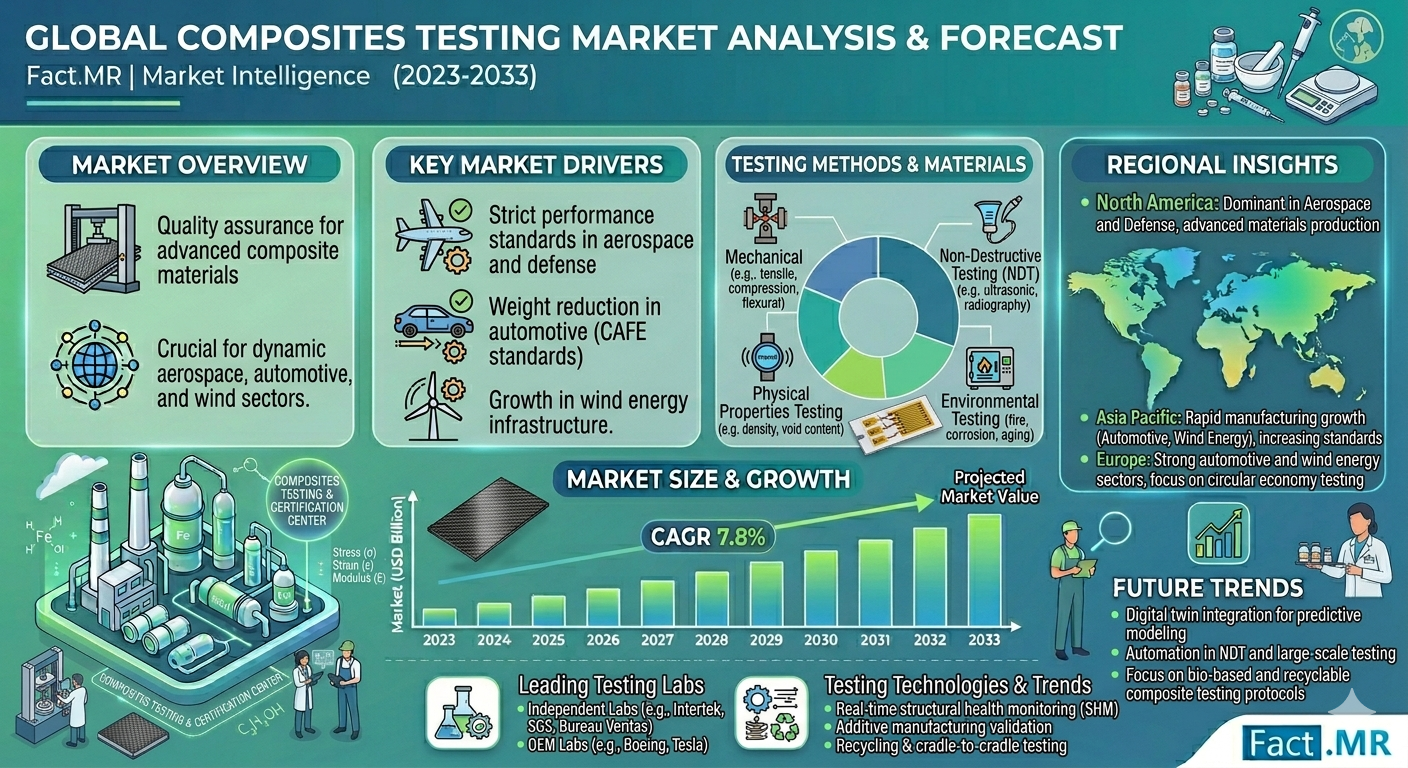
ROCKVILLE, MD, UNITED STATES, March 31, 2026 /EINPresswire.com/ -- As aerospace and renewable energy sectors face tightening airworthiness and safety regulations, the global Composites Testing Market is undergoing a structural shift. According to the latest analysis from Fact.MR, the industry—valued at USD 2.1 billion in 2026—is set to reach USD 3.49 billion by 2036, expanding at a steady 5.2% CAGR.The surge is primarily driven by a "capacity-constrained" environment. Aerospace OEMs and wind energy giants are initiating massive test programs, spanning thousands of coupons to full-scale structural validations. For decision-makers, the message is clear: securing accredited laboratory capacity is no longer just a procurement task—it is a strategic necessity to avoid production delivery penalties.
Get Access Report Sample :
https://www.factmr.com/connectus/sample?flag=S&rep_id=6405
The Executive Summary: Market at a Glance
Metric
Details
Market Value (2026)
USD 2.1 Billion
Projected Value (2036)
USD 3.49 Billion
Growth Rate (CAGR)
5.2%
Absolute $ Opportunity
USD 1.39 Billion
Lead Segment
Destructive Testing (58% Share)
High-Growth Segments & Strategic Insights
The complexity of modern materials like Carbon Fiber Reinforced Polymers (CFRP) has made testing a non-negotiable phase of the product lifecycle.
Destructive Testing Dominance: Holding a 58% market share, this segment is projected to grow at an 5% CAGR. Its ability to provide immediate, empirical data on material failure remains the gold standard for safety-critical industries like Defense and Construction.
The Rise of Ceramic Matrix Composites (CMCs): Slated for a 3% CAGR, CMCs are becoming the go-to for high-temperature environments, specifically in next-generation jet engines and turbine blades.
Regional Powerhouses: While the U.S. remains a dominant force with a 5% CAGR, China is setting the global pace at 6.0%, fueled by rapid urbanization and massive investments in its domestic EV and space sectors.
Analyst Perspective: Navigating the Bottleneck
"The industry is currently operating under intense pressure," notes the lead analyst at Fact.MR. "Testing laboratories that lack specialized accreditations like Nadcap or ISO 17025 are being sidelined from high-value contracts. For manufacturers, delaying the initiation of a test program by even a few weeks can result in cascading certification delays that threaten the entire commercial launch of a platform."
Strategic Takeaways for Decision-Makers:
For Laboratories: Priority should be placed on automated specimen preparation and high-throughput test frames to capture the rising volume of aerospace contracts.
For OEMs: To mitigate risk, companies must establish multi-laboratory frameworks rather than relying on a single service provider.
Global Growth Trajectories (2026–2036)
The shift toward lightweighting and fuel efficiency is a global phenomenon, with several key regions showing accelerated adoption:
South Korea (5.6%): Heavily driven by Hyundai and Kia’s push for lighter EVs.
Germany (5.3%): Focused on maintaining the structural integrity of high-performance automotive designs.
Japan (5.2%): Leading in aerospace innovation and renewable energy infrastructure.
Browse Full Report –
https://www.factmr.com/report/composites-testing-market
To View Related Report:
Biocomposites Market https://www.factmr.com/report/biocomposites-market
ReGen Composites Market https://www.factmr.com/report/regen-composites-market
Sports Composites Market https://www.factmr.com/report/sports-composites-market
Marine Composites Market https://www.factmr.com/report/marine-composites-market
S. N. Jha
Fact.MR
+ +1 628-251-1583
email us here
Legal Disclaimer:
EIN Presswire provides this news content "as is" without warranty of any kind. We do not accept any responsibility or liability for the accuracy, content, images, videos, licenses, completeness, legality, or reliability of the information contained in this article. If you have any complaints or copyright issues related to this article, kindly contact the author above.
